A note on what this is and is not
This is an article about tools for capturing ideas, written for adults who describe their thinking as scattered, fast, or hard to file. Some of them have an ADHD diagnosis and some do not.
oThought is not a medical product, not a treatment, and not therapy. None of the apps below are either. They do not assess or diagnose anything, and nothing here is clinical advice. If symptoms affect your daily life, that is a conversation for a qualified professional, not for an app.
What to look for when ideas are the problem
Most lists of ADHD apps are about time, focus, and routines. Losing ideas is a different problem. The ideas arrive constantly, often mid-task, and the standard advice then asks for six small steps: name it, tag it, pick a project, review it on Sunday. Each step is a place to stall.
Three things decide whether an app survives that:
- Capture takes one action. No title, no folder, no form.
- The structure lives outside your head. Sorting and connecting happen without your attention.
- It survives a missed month. Nothing to catch up on when you come back.
The apps adults with ADHD actually use for ideas
- Voice memo apps, such as Apple Voice Memos or Google Recorder. The fastest capture there is, and free. The cost comes later: nothing happens to a recording after you stop it, so you end up with a pile of files named by date that you will not replay.
- Task managers, such as Todoist, Things, or TickTick. Excellent once an idea has become a task. They ask you to type it, name it, and file it at the moment you have it, which is exactly the step that fails.
- Visual planners, such as Tiimo. Built to give the day a visible shape and make routines easier to follow. Useful for doing, less so for catching a thought on a walk.
- Body doubling, such as Focusmate. Working alongside someone else helps many people start. It stores nothing, so it pairs with a capture tool rather than replacing one.
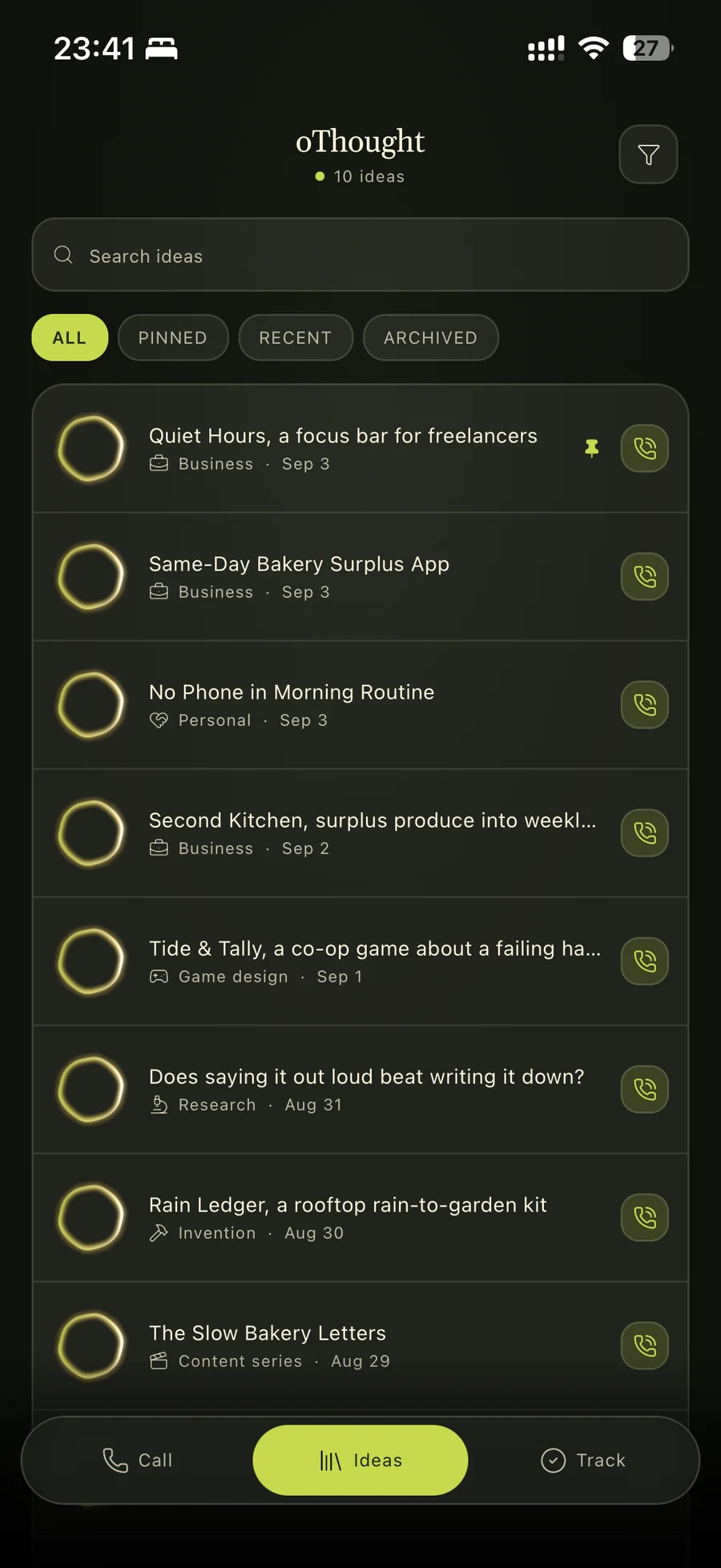
- A call-first thought partner, such as oThought. You call it or leave a voicemail, talk, and hang up. It saves the idea, researches it, and plans a first step in the background. The limits are real: voice minutes are capped, and it needs a connection.
Many people combine two of these: one for catching ideas and one for doing the work. The rest of this article is about the first half, because that is where ideas get lost.
Why talking works better than typing here
Typing an idea forces you to serialise it while you are still thinking it. You pick a first word, which means you pick a framing, and the other three ways to describe it are gone. For fast, branching thinking that is an expensive trade.
Speaking has room for the branches. You can trail off, come back, and say "actually the real thing is" halfway through. That is useful signal, and typing deletes it because typing invites editing.
oThought asks one question at a time rather than handing you a form, and saves the idea the moment a remark turns into one, while you carry on talking. There is no filing step, because a filing step is where this breaks. The practical method is in how to capture ideas by voice without typing.
What happens to the pile afterwards
Capturing more only helps if the pile becomes navigable. After a call, background research attaches sources with the retrieval date and a confidence label, so you can see what is solid and what is thin without re-reading everything.
Ideas then connect in a Mastermind Map. For scattered thinking this is the part that pays off: the link between the thing you said in March and the thing you said in August is exactly the link you will not make on your own.
When one idea deserves real effort, a Deep Pack is a one-time purchase that runs planning agents on it and returns a multi-document PDF. Turning an idea into a starting point is covered in from idea to first step.
Keep the expectations honest
No app fixes focus. Moving structure outside your head removes a category of friction, which is a real improvement and a limited one. You will still have days where nothing gets started, and an app that promised otherwise would be lying.
Most captured ideas also go nowhere, and that is the correct outcome. You capture them anyway because you cannot tell in the first minute which ones matter.
To test whether talking beats typing for you, the free trial is 10 voice minutes and 2 saved ideas, no card required. Pro is $2.99 per week or $29.99 per quarter and Founder is $9.99 per week or $99.99 per quarter. There is no unlimited voice plan. oThought runs on iOS 16.4 or later, iPad, and Android 8 or later, in 19 languages.
Questions
Is oThought an ADHD app or a treatment?
No. It is an idea capture and thinking tool. It does not diagnose, assess, or treat anything, and it is not a substitute for advice from a qualified professional.
Which app should I try first if I keep losing ideas?
Start with the capture step, because that is where ideas get lost. A voice memo app costs nothing to try; a call-first tool like oThought adds the sorting and follow-up afterwards. Keep whatever task app already works for you.
What if I abandon the app for a month?
Nothing breaks in oThought. There is no review ritual to fall behind on and no inbox to clear. Saved ideas keep their context, and the next call can pick up where your thinking left off.