A list is the wrong shape for ideas
Ideas do not arrive in a sequence and they do not belong in one. The note you made in March about how badly a workflow fits small teams and the note you made in August about a pricing problem are probably the same observation. In a list they are item four and item nineteen, and you will never put them side by side.
Lists sort by time, which is the one dimension that says nothing about meaning. Folders are worse, because they force a single home for something that belongs in three places, and you spend the decision energy at exactly the moment you were trying to capture quickly.
The useful shape is a graph. Ideas as nodes, relationships as edges, and the structure emerging from the content rather than from your filing discipline.
What the Mastermind Map is in oThought
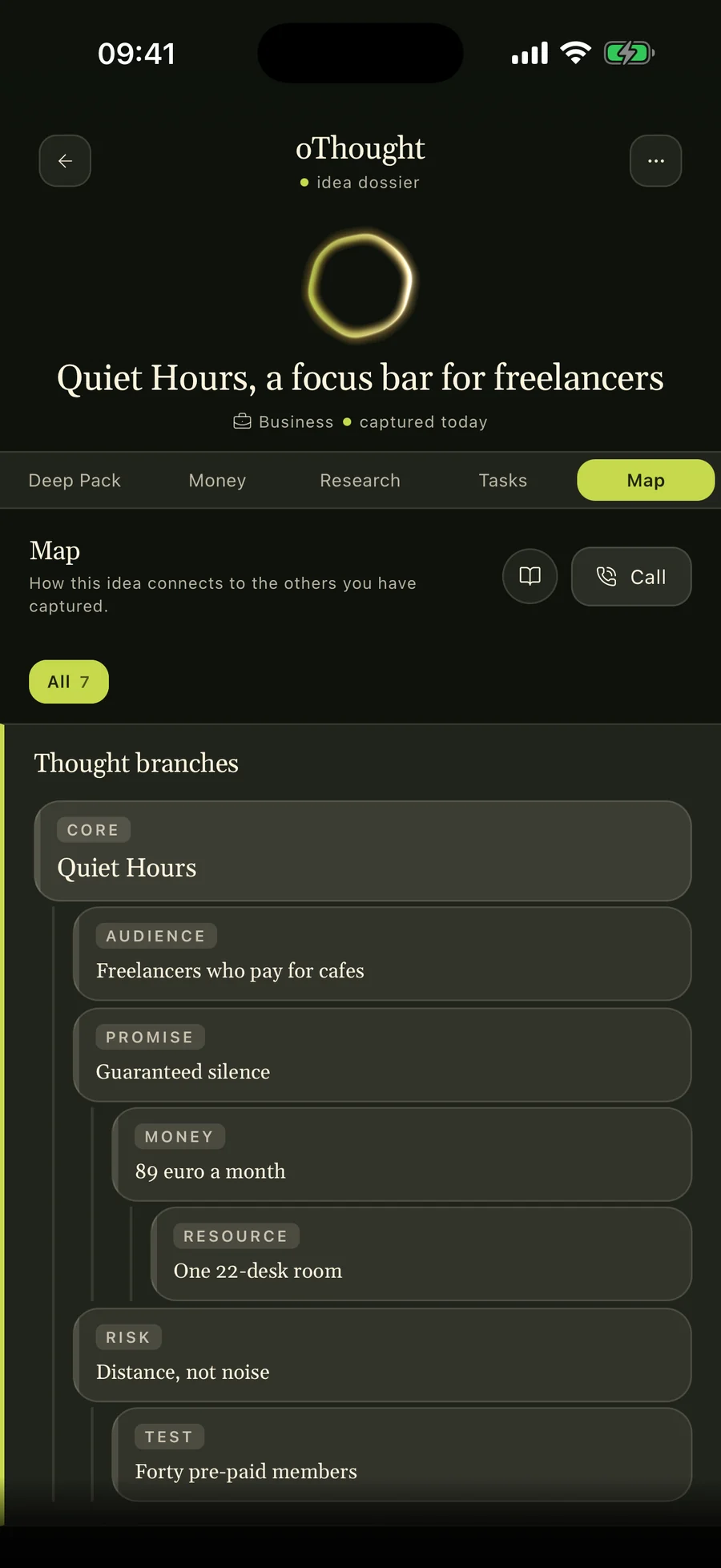
Every idea saved during a call becomes a node. As more ideas accumulate, they connect to each other, and the map is where you see the connections.
It is built from ideas, not from documents. A note-taking graph links pages you wrote. This links things you said were ideas, which is a much higher bar and keeps the map from filling up with meeting notes and shopping lists.
It is also meant to get clearer over time rather than denser. A graph that adds an edge for every weak similarity becomes unreadable at around a hundred nodes, which is the failure mode of most personal knowledge graphs. Clarity is the goal, not edge count.
Ideas in the map carry what the background work produced: research with the source, the retrieval date, and a confidence label attached, so you can tell a checked claim from a thin one without opening every node. Where a fact came from is part of the idea, not a footnote.
Why this is not a second brain
The second brain idea has a real insight in it: your memory is unreliable, so write things down and build an external system. Where it usually goes wrong is the maintenance bill.
Most second brain setups ask you to capture, then process, then link, then review on a schedule. Four habits. The capture habit survives. The other three collapse within a couple of months for most people, and what remains is a large collection of unprocessed notes plus a quiet feeling of being behind on your own system.
The Mastermind Map is built to avoid the bill. You do not link ideas manually. You do not maintain a taxonomy. You do not have a weekly review to skip. Ideas are detected and saved during the call, and the connecting happens in the background.
The trade is real and worth saying plainly. A hand-built graph reflects exactly how you think, because you drew every edge. An automatic one will sometimes connect things you would not have, and miss a connection you find obvious. In exchange, it still exists in six months. For most people that trade is the right way round, because a perfect system you abandoned is worth nothing.
What it is actually good for
Three things, mostly.
Seeing what you keep returning to. When four separate captures across two months turn out to orbit one problem, that is the strongest signal you have about what to work on. It is invisible in a list and obvious in a map.
Finding the combination. Two ideas that were mediocre alone are occasionally one good idea together. This is where most of the value shows up, and it only happens when both were captured and both are visible at the same time.
Picking up context after a gap. Come back after three weeks away and the question is "what was I doing?" The map answers with structure instead of asking you to read twenty notes in reverse order. The next call can start from that context too, which is the difference between resuming and restarting.
How ideas get into it
You do not add them. You call oThought and talk, or leave a voicemail, and ideas are detected and saved while the conversation carries on. Nothing pauses so you can file something.
That matters more than it sounds, because a map is only as good as the capture rate feeding it. A graph tool with a five-minute entry cost gets the ideas you had time to write up, which is a biased and small sample of the ideas you had. Capture by voice and the sample is closer to complete. The method is in how to capture ideas by voice without typing.
When one node in the map is worth real effort, a Deep Pack is a one-time purchase that runs planning agents on that single idea and returns a multi-document PDF. The map is where you decide which idea earns it, and from idea to first step covers what to do next.
What it is not
It is not a mind map you draw. There is no canvas where you place boxes and drag arrows between them. If diagramming a topic on purpose is what you want, a mind mapping tool is the right tool and this is not competing with it.
It is not a project manager. There are no sprints, no assignees, no board of tickets. It is a picture of your thinking, not a system of record for work.
It is not a wiki. You are not writing pages. You are talking, and the structure is a by-product.
Saved idea limits follow the plan: the free trial holds 2 saved ideas with 10 voice minutes and no card, Pro is $2.99 per week or $29.99 per quarter, and Founder is $9.99 per week or $99.99 per quarter. The app runs on iOS 16.4 or later, iPad, and Android 8 or later, in 19 languages, and it is made by Taskless in Eindhoven.
Questions
Do I have to link ideas myself?
No. Ideas are captured during calls and connect to each other in the map without manual linking, tagging, or a folder structure to maintain.
How is this different from a mind map?
A mind map is something you draw about one topic on purpose. The Mastermind Map is built from ideas you actually had across many calls, and it is meant to reveal patterns you did not plan to look for.
Does the map get messy as ideas pile up?
It is designed to get clearer rather than noisier as it grows. The map connects ideas saved from calls, not every note or document, which keeps the signal higher than a general knowledge graph.