These are two different jobs
Voice recording tools and thought partners get compared constantly, and the comparison usually goes badly because people treat them as competitors for the same job. They are not. One is a capture device. The other is a participant.
A capture device is measured on fidelity and speed. Did it get every word, did it start instantly, can you find it later. A participant is measured on what the conversation produced. Did you leave knowing something you did not know when you started.
If you only need the first thing, the tools below are good at it, and you do not need anything else.
What the recorders do well
Apple Voice Memos is the default on every iPhone, it opens instantly, and it never asks you to sign in. For pure capture with zero setup, that is hard to beat. It is a recorder, and it is honest about being one.
Otter is built around meetings. It transcribes conversations with multiple speakers and gives you a searchable record of who said what. If your problem is that you cannot take notes and participate in a meeting at the same time, that is the category it serves.
Voicenotes is designed for personal voice capture, with transcription and search over what you have recorded, so your own spoken notes stop being an unlabeled pile of audio files.
AudioPen takes a spoken ramble and rewrites it into clean, readable text. If your issue is that you speak well but write slowly, that turns talking into a drafting method.
All four are well-made tools with a clear purpose. Nothing below is an argument that they are bad at what they do. We are describing only what each is widely known for, because inventing details about someone else's product would be exactly the kind of thing this blog is not for.
Where the recorder model runs out
The common shape is: you talk, it stores, and optionally it cleans up the text. The loop closes when the recording ends. Everything after that is your job.
That is fine for a grocery list and thin for an idea. An idea in its raw state is usually missing the thing that would tell you whether it is worth pursuing, and you do not know what that thing is, because if you did you would have said it. A recorder cannot tell you either, because it has no view on your idea. It has a transcript of it.
The second limit is accumulation. After a month of diligent capture you have a folder. Search helps if you remember the words you used. It does not help with the question that actually matters, which is "what have I been circling for the last three months without noticing?"
What a thought partner adds
oThought is call-first. You call it and have a conversation, or leave a voicemail when a live call is not practical. During the call it asks the follow-up question a friend would ask, and it notices when a passing remark has become an idea worth keeping, saving it without making you stop to file anything.
The bigger difference is what happens after you hang up. Background research runs on the saved idea and attaches what it finds with the source, the retrieval date, and a confidence label. That last part matters more than it sounds. A finding you can check is worth something. A confident summary with no trail behind it is worth very little, and there is a lot of the second kind around.
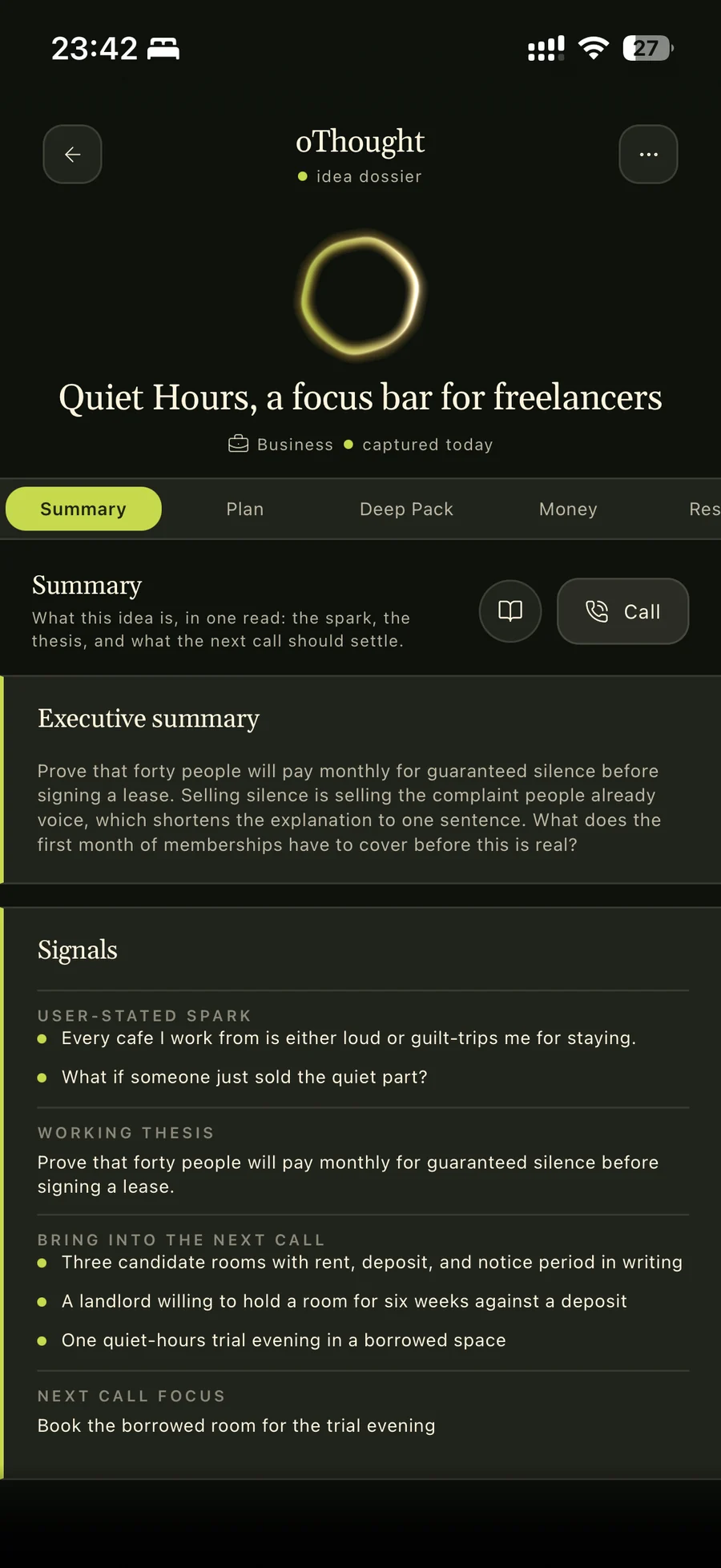
Saved ideas also connect to each other in a Mastermind Map, so the pile becomes a structure. The recurring theme surfaces because the relationships are drawn, not because you remembered to look.
When one idea deserves serious work, a Deep Pack is a one-time purchase that runs planning agents on that single idea and hands back a multi-document PDF. You choose the idea, and you choose whether it is worth it.
An honest comparison
Use a recorder when you want a faithful record of something that was said and you already know what to do with it. Meeting minutes. A quote you want to keep. A shopping list on the way to the car. Speed and fidelity are what you want, and extra intelligence is friction.
Use a rewriter like AudioPen when you have the thought fully formed and the bottleneck is turning it into readable text. That is a drafting problem, and a drafting tool solves it.
Use a thought partner when the idea is not finished, when you are not sure what you think yet, and when the value is in the questions you have not asked. That is the only case where a conversation beats a recording, and it is a common case for people building things.
The costs differ too. A recorder is close to free because storing audio is cheap. Live voice conversation and background agents are not cheap, which is why oThought meters minutes instead of promising unlimited. The free trial is 10 voice minutes and 2 saved ideas with no card. Pro is $2.99 per week or $29.99 per quarter. Founder is $9.99 per week or $99.99 per quarter. There is no unlimited plan, and that is a deliberate choice rather than a gap in the lineup.
You can use both
This is not a migration. Plenty of people keep the default recorder for quick factual captures and call a thought partner when an idea needs pushing on. The two habits do not conflict, and treating every spoken note as a thinking session would be exhausting.
A reasonable split: if you already know what the note is for, record it. If you catch yourself saying "I need to think about this properly at some point", that is the one worth a call, because "at some point" is where ideas go to die.
If you want the method for the capture side, read how to capture ideas by voice without typing. If you want to know why this is a phone call rather than a chat box, that argument is here.
Questions
Is oThought a transcription app?
No. It captures the call and keeps the transcript, but the point is the conversation and what happens afterwards: idea detection during the call, background research with sources, a map of how your ideas connect, and a plan you can start from.
Can I keep using Apple Voice Memos or Otter alongside it?
Yes, and many people should. Recorders are better for factual captures and meeting records. A thought partner is for ideas that are not finished yet. They solve different problems.
Why is there no unlimited voice plan?
Live voice and background agents cost real money per minute. Pro gives $2.99 per week or $29.99 per quarter, Founder is $9.99 per week or $99.99 per quarter, and top-ups add minutes when you need them. Metering openly is more honest than an unlimited label with a hidden ceiling.