The idea is not lost, the keyboard is just too far away
Most good ideas show up at the worst possible moment. On a walk. In the shower. Driving. Two minutes before you fall asleep. Halfway through a task you cannot pause. The thought is complete in your head for about forty seconds, and then something else takes the slot.
The usual fix is a notes app. You unlock the phone, find the app, pick a note, and start typing. By the time the cursor blinks you are already editing. You write a title you do not need. You shorten the thought so it fits on one line. What lands in the note is a compressed souvenir of an idea, not the idea.
Voice skips all of that. Talking is the fastest interface you own, and it is the only one that keeps working while your hands and eyes are busy. The problem has never been that people cannot describe their ideas. The problem is that describing them in text costs more attention than the moment allows.
Say the raw thought first, structure it never
The single habit that makes voice capture work: say the messy version. Do not open with a summary. Do not decide whether the idea is good. Start in the middle if that is where you are.
A raw capture usually sounds like this: what you noticed, who it is for, and why it bothered you. That is enough. It does not need a name, a category, or a next step. Those are downstream jobs, and doing them in the first sixty seconds is how you talk yourself out of the idea before it exists.
Three prompts get almost anything out of your head:
- What did I just notice?
- Who would care about it?
- What would have to be true for it to work?
Answer those out loud and you have a usable capture. You do not have to answer them in order, and you do not have to answer all three.
Recording is only half of it
Here is where most voice workflows stall. You record a five-minute ramble, and now you own a five-minute ramble. A week later you have eleven of them, none titled, none searchable, and listening back costs more time than it did to record. Transcription helps a little. It turns audio you will not replay into text you will not read.
The missing piece is a second party. When you talk to a person, they ask the one question that unlocks the rest. They say "wait, for who?" and you discover the idea was about a different audience than you thought. A recorder cannot do that, because a recorder has no stake in the conversation.
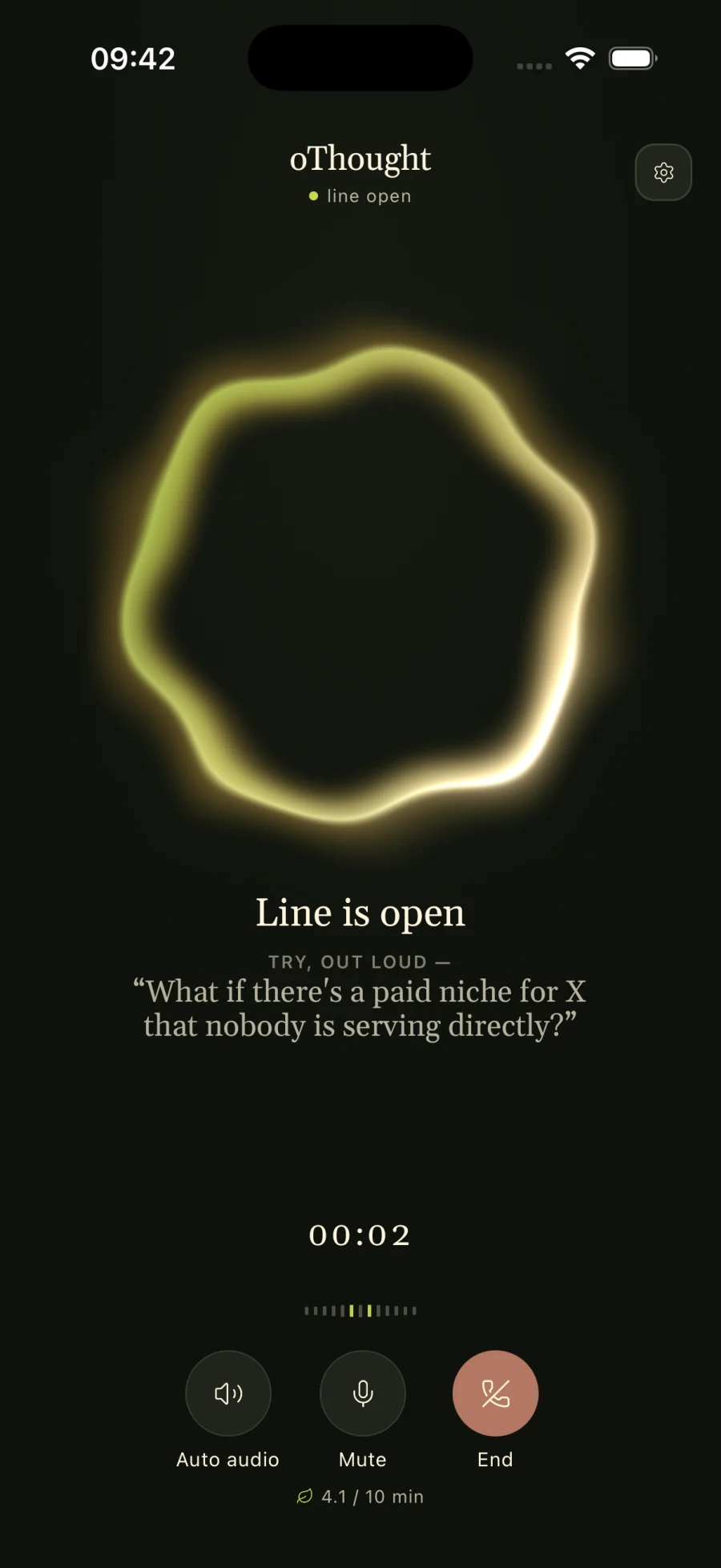
That is the gap oThought was built for. It is call-first: you call it, or leave a voicemail if you would rather not talk live, and you get an actual back and forth instead of a blinking red dot. It asks the follow-up. It notices when a passing remark has turned into an idea, and saves that idea while you keep talking, so nothing stops to be filed.
A workflow that survives real weeks
Voice capture fails when it needs discipline. Build it so it needs almost none.
Keep one place. Not a voice recorder plus a notes app plus a task list. One destination, so you never spend the forty-second window deciding where the thought goes.
Capture at the moment, not at the desk. If you tell yourself you will write it down later, you are betting against a version of yourself who will be tired. Talk now, even badly.
Let it be long. There is no prize for a short capture. If the idea takes four minutes to describe, take four minutes. Compression is a job for later, and it is a job for software.
Do not review daily. A capture habit that comes with a nightly sorting ritual is two habits, and the second one collapses first. Capture should be one-directional. The sorting has to happen without you.
Expect most of them to be bad. The value of capturing everything is that you stop pre-judging, and pre-judging is what kills the good ones along with the rest.
What happens after you hang up
Capture only matters if the idea is findable and further along when you come back. After a call, oThought works on the idea in the background rather than parking it. Research runs and attaches what it finds with the source, the date it was retrieved, and a confidence label, so you can tell a solid reference from a thin one at a glance instead of trusting a summary.
Saved ideas connect to each other in a Mastermind Map, which is where the compounding happens. The app idea from March and the frustration you described in July turn out to be the same idea, and you only see that because both were captured instead of one being tidied away.
When one idea is worth real effort, a Deep Pack is a one-time purchase that runs planning agents on that single idea and delivers a multi-document PDF you can actually work from. Nothing about it is automatic. You pick the idea.
None of this asks you to maintain a system. That is the point. The work after the call is the product's job, not a chore you inherit.
What to expect the first week
The first few calls feel odd. Talking to software without a person listening takes a couple of tries before it stops feeling performative. Most people get past that on the second or third call, usually the one where they are annoyed about something and forget to be self-conscious.
You will also notice that you repeat yourself. Three ideas in a week will turn out to be one idea approached from three angles. That is not wasted capture, it is signal. The thing you keep circling back to is usually the thing worth building.
The free trial gives you 10 voice minutes and 2 saved ideas, no card. That is enough to find out whether talking works better for you than typing. If it does, Pro is $2.99 per week or $29.99 per quarter, and Founder is $9.99 per week or $99.99 per quarter. There is no unlimited voice plan, because voice minutes cost real money to run and a plan that pretends otherwise ends up rationing you quietly instead.
If you want the longer argument for why this is a call and not a chat box, that is here. If you are comparing against a recorder you already use, start with voice notes versus a thought partner.
Questions
Do I have to talk out loud, or can I type the idea?
oThought is built around talking. You call it and speak, or leave a voicemail if a live call is not practical. That is deliberate: typing is the step that makes people compress an idea before it is finished.
What if my idea comes out as a mess?
That is the expected input. Say it in whatever order it arrives. The call pulls out more detail while you talk, and the cleanup happens afterwards rather than while you are still thinking.
How long does a capture call need to be?
As long as the idea takes. Many are under two minutes. The free trial includes 10 total voice minutes, which is enough to capture several ideas and see whether the format fits you.