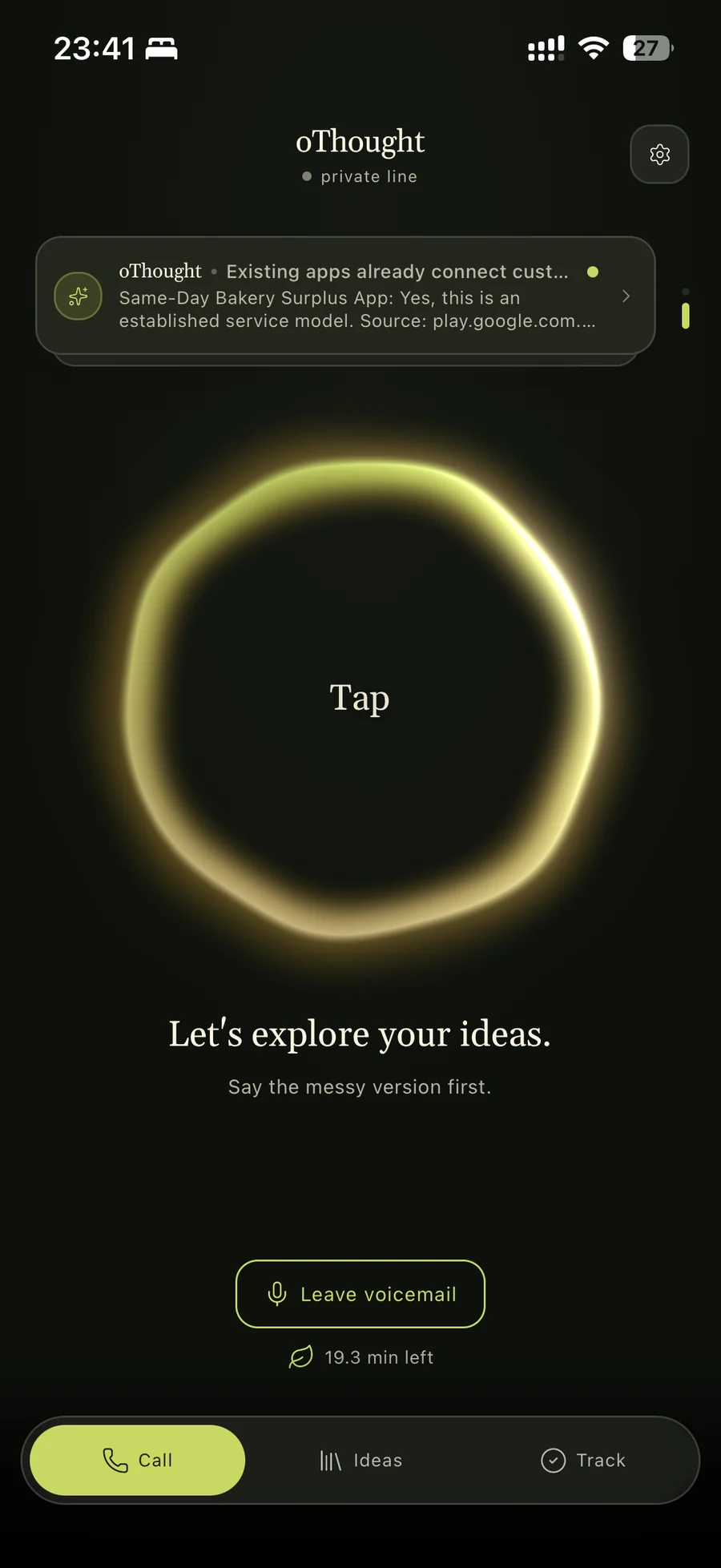
A chat box asks you to perform
Open a text box with a cursor in it and something changes in how you think. You compose. You choose a first sentence that frames the whole thing. You delete the vague part because it looks bad written down, and the vague part was often where the idea actually lived.
Writing is an editing medium, and editing is a filter applied before you have finished thinking. For polished output that is exactly what you want. For working out what you think, it removes the material.
There is a second effect that is easy to miss. In a chat, the burden of the next question sits with you. Nothing happens until you type again. So the depth of the session is capped by how good your questions are on a tired Tuesday evening, which is not when anyone's questions are good.
What a call does differently
On a call you talk at the speed of thought, which is considerably faster than you type and far less filtered. You say the part you would have deleted. You trail off, come back, and say "no wait, the real problem is", and that sentence is usually the most valuable one in the whole call.
The other side asks the next question, so the conversation does not stall when you run out of prompts. That is the difference between a tool that answers and a tool that pulls. A friend who is good to think with is not good because they know more than you. They are good because they ask the question you were avoiding.
Calls also have a natural shape. They start, they go somewhere, they end. A chat thread has no end, which sounds like freedom and in practice means it never gets closure and never gets revisited.
So oThought opens on a call surface. One primary tap and you are talking. If a live call is not practical, you leave a voicemail instead, and the same work happens afterwards.
Talking works where typing cannot
This is the plainest argument and it gets underrated. You can talk while walking, driving, cooking, or standing in a car park before going inside. You cannot type in any of those, and those are exactly the moments when ideas show up, because your attention is loose enough to let them.
A tool that only works at a desk collects the ideas you had at a desk. That is a biased sample and a small one. Voice widens it, and the width is most of the value.
The method for making this a habit is in how to capture ideas by voice without typing.
The call stays short because the work is elsewhere
A live call is a bad place to do research. If the voice pauses for eleven seconds while something looks things up, the conversation is dead and you will not call back.
So the split is deliberate: the call is for talking, and everything slow runs after you hang up. Research, planning, cleanup, and the briefing for your next call all happen in the background. The live voice layer stays fast because it is never waiting on any of that.
It is also why ideas are detected and saved during the call rather than afterwards by you. The moment an idea is born is the moment you are least willing to stop and file something, so nothing asks you to.
What comes back has provenance attached. Background research stores the source, the date it was retrieved, and a confidence label, so a claim you can check looks different from a guess. User-stated facts, AI inference, and external research stay distinguishable rather than blending into one confident paragraph.
What call-first rules out
A product philosophy is only real if it excludes things. This one excludes a fair amount.
It is not a chat-first app, and a chat box is not getting bolted on as the main way in. It is not a notes dashboard, not a task manager, and not a general productivity suite. Each of those is a reasonable product and none of them is this one.
It also rules out an unlimited voice plan. Live voice costs money per minute, and an unlimited offer is usually not unlimited: it gets rationed quietly through throttling or degraded models. Metering openly is the less appealing option on a pricing page and the more honest one in practice. The free trial is 10 voice minutes and 2 saved ideas with no card. Pro is $2.99 per week or $29.99 per quarter. Founder is $9.99 per week or $99.99 per quarter.
Where the call leads
A call on its own would be a pleasant conversation you forget. What makes it worth repeating is what accumulates.
Ideas from calls connect to each other in a Mastermind Map, so a pattern across months becomes visible instead of staying a vague feeling. The next call can start from that context, which is why the second month is more useful than the first.
When one idea is worth committing to, a Deep Pack is a one-time purchase that runs planning agents on that single idea and delivers a multi-document PDF. Going from a captured idea to something you can start is covered in from idea to first step.
If you are weighing this against a recorder you already use, the honest comparison is in voice notes versus a thought partner.
The test we hold it to
One sentence decides whether this is working: you should be able to say everything out loud, and none of it should disappear.
Everything in the design serves that. The call starts in one tap so the moment is not lost to navigation. The greeting is short because you came to talk. Ideas save themselves so capture costs nothing. The slow work waits until you have hung up.
If a future feature makes the call slower, the capture more manual, or the conversation more like typing, it fails that test regardless of how good it looks in a screenshot.
Questions
Can I type to oThought instead of calling?
The product is built around talking. You call it, or leave a voicemail when a live call is not practical. That is a deliberate constraint: typing filters the idea before you have finished having it.
Why does the call stay short instead of doing research live?
Research and planning run in the background after you hang up, so the live voice layer never waits on slow work. A conversation that pauses to look things up stops being a conversation.
Which devices and languages does it support?
oThought runs on iOS 16.4 or later, iPad, and Android 8 or later, and the app ships in 19 languages. It is made by Taskless in Eindhoven, the Netherlands.